The sign of the unicorn. A fabric shop for 18th century reenactors and historians.

18th Century Cotton Prints

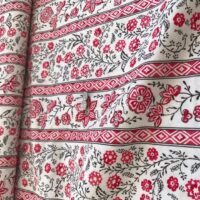
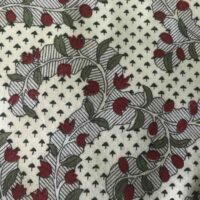
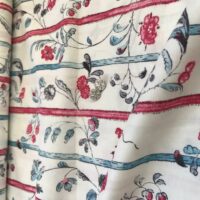
These printed cottons that are true copies of the original designs are now available thanks to the work of the people at Durán Textiles from Stockholm, Sweden.

Using examples of textiles from clothing in museum collections in Sweden and the USA they have presented us the opportunity to fulfill the desire to add clothing to our wardrobe that will produce not only the correct print but also the proper drape of the fabric for the late 18th century.

Printed cottons made before the process became much more sophisticated in the early 19th century have a charm that was lost with the advent of the roller printing machines. Some of the prints offer the sought after monochrome designs on a light background that in the period were printed using the color resist method or by block printing, others are block printed with the blues and yellows "penciled' in. Today Durán Textiles has used the block printed method to duplicate some of the original designs while others are screen prints.

You may choose to make an entire printed gown, a jacket or a banyan and have a garment to be proud of. Alternatively you may buy a small piece to border a petticoat, line the turn back cuffs on your short gown or to make a pair of pockets adding a touch of luxury to your wardrobe. The preshrunk cotton fabric from Durán Textiles will only produce 2-3% shrinkage with washing: all are 59" (150cm) wide.

All fabrics noted below are currently in stock others may be special ordered with a 50% deposit. Due to the exchange rate all special orders will be placed at the new price and any orders less than 25 meters will be charged an additional 10%. To see Durán Textiles complete line of fabrics please visit their website: Durán Textiles, AB.

You may special order any Durán Textiles fabric from
Wm. Booth, Draper at the sign of the Unicorn
.
262-886-9133 or 815-648-9048.

home
Top

Anamon WDT 101
56" wide $34.00/yd.

Woman's short loose gown "Kofta", Fornsalen, county museum of Gotland, Visby, inv. nr. 24.

Block print on cotton. The fabric has first been printed with reserve paste and dyed red, then printed with black, finally the yellow and grey details were hand painted.

The fabric can be dated to the mid 18th century. For example in The Virginia Gazette of 1774, "COMMITTED to the Jail . . .  a Man and Woman, supposed to be runaway from Maryland . . .  The Woman says she is his Wife . . .  had on a . . .  red printed Linen Gown".

Add Anamon WDT 101 to Cart

Calico cotton swatch for 18th century reenactors, 18th century interior designs, and historic interpreters.
home
Top
Replica of a printed cotton swatch for 18th century reenactors, historic interior designs, and historic interpreters.

Shell WDT 102
is available white/brown (in stock),
white/blue or white/red (special order only) 56" wide $34.00/yd.

Block printed cotton dated 1760-80 used as lining for a Banyan that is in the collection of the Winterthur Museum, Delaware.

The original print is brown on a light ground; the others use common printed colors. These one color prints were the most common and least expensive in the 18th century. Small patterned monochrome prints were used as linings for clothing as well as furnishing. Besides banyans this fabric will make an attractive woman's gown or petticoat or man's waistcoat.

Another example is in The Pennsylvania Chronicle of 1772 "Ran away . . .  an indented servant woman . . .  had on when she went away, a blue and white linsey petticoat, blue and white figured callico gown".

Add Shell WDT 102 to Cart

home
Top
Historically accurate reproduction 18th century printed cotton fabric swatch for 18th century re-enactors, reproduction 18th-century upholstery, and historic museum interpreters.

Brown Klint
(in stock) 59" wide
$35.00/yd.

This is copied from the hem facing of an underpetticoat dated to 1780-1800 in the Chester County (Pennsylvania) Historical Society 00/76CLF 186 B. The original is a printed linen, two color brown on off white ground.

This is a two color print of two shades of brown being one of the most common prints available in the 18th century. Brownish black, brown and shades of red were the pigments that best suited the 18th century printing technology.

Pictured in Fitting and Proper by Sharon Ann Burnston pages 26-27. Also for example in The Pennsylvania Evening Post in 1777 "Ran away from . . .  Philadelphia, a Scotch Servant Girl . . .  She had on, and took with her, a black long gown, printed short ditto".

Add Brown Klint to Cart

home
Top

Dorotea
$39.00/yd. 59" wide

This print being dated to c. 1800 is copied from one on a sweedish apron now in the collection of Värmland’s Museum, Karlstad (inv.nr: VM 6608). Although originally printed on a brocade cambric it is reproduced on a plain weave.

This is block printed in brown with ocher red flowers. Being a true block print, misalignments may be seen in the brown stems and sometimes the printer did not push hard enough so that the dye did not take evenly. These imperfections give this fabric true character consistent with the time period. For example in Rhode Island's Newport Herald, of 1788 "RAN-AWAY . . .  a wench . . .  had on and took with her three gowns, one a striped cotton, a light chints small figur'd, and a calico".

Add Dorotea to Cart

Historically accurate reproduction early 19th century printed cotton fabric swatch for new republic, reproduction upholstery, and historic interpreters.
home
Top

Veronica WDT 105
brown monochrome print also available in black
59" wide $34.00/yd.
(brown in stock, black special order only)

Panel of block printed cotton dated 1760-80, provenance unknown, from the collection at Winterthur Museum, Delaware. The original fabric is printed brown on a white ground.

The brown and red colors were often achieved by printing with mordents on the printing blocks and dyed with madder. Different chemicals gave a variation of red and brown hues from the same dye pot. The untreated surfaces remained white. The printed cottons with big repeats were used both for clothing and as interior fabrics like curtains, bedspreads and covers.

In 1777 in The Providence Gazette "was stolen and carried away from the house of the subscriber, one calico gown, with ruffled cuffs lined with Russia linen. The person who stole the said articles had on when she went away a short calico gown with long sleeves".

Although calico can be tightly woven white cotton often calico had an all-over print, usually in a small floral pattern. The large pattern of Veronica would be appropriate for a gown or for furnishing fabric but it is too large for a smaller garment such as a woman's jacket.

Add Veronica WDT 105 to Cart

Historically accurate reproduction 18th century printed cotton fabric swatch for 18th century reenactors, historic reproduction interior upholstery design, and museum interpreters.
home
Top
Printed cotton fabric swatch of an original printed cotton for 18th century reenactors, historic home upholstery, and museum interpreters.

Daisy WDT 106
59" wide available in gold (top, special order only) pale blue (center, in stock),
and beige (lower, special order only) $34.00/yd.

The original printed fabric was used to make a shortgown, which is lined with off-white linen and has sleeve facings in another print and is illustrated in Fitting and Proper by Sharon Ann Burnston, p. 23.

"Typical of those from the 1780s to 1790s, this print has small flowers and a striped ground. Printed cotton like this is ideal for late American Revolution up to 1830s gowns and petticoats.

For example in The Proceedings of the Old Bailey, London 1782 "FRANCES FIELDING was indicted for stealing two printed cotton gowns, value 20 s." The shortgown was an everyday garment worn mostly by Quakers and German-Americans, but by many others as well. It was a practical working garment, nearly always made of printed cotton or linen. It had a very simple cut, in one piece, without shoulder seam and sleeves cut with the body

Add Daisy WDT 106 to Cart

home
Top
Historically accurate reproduction 18th century printed cotton fabric swatch for 18th century re-enactors, reproduction 18th-century upholstery, and historic museum interpreters.

Klint WDT 108
(in stock) 56" wide
$24.95/yd.

Hem facing band from underpetticoat 1780-1800
Chester County (Pennsylvania) Historical Society 00/76CLF 186 B
Printed linen, brown on off white ground.

Printed fabrics were often used as linings and, as in this petticoat, as decorative and functional facings. The brown colour was considered appropriately humble by the Quaker families who used the garment. Brownish black, brown and shades of red were the pigments that fitted the 18th century printing technology. These colors dominate the early prints.

Pictured in Fitting and Proper by Sharon Ann Burnston pages 26/27

Add Yellow Klint WDT 108 to Cart

home
Top
Historically accurate reproduction 18th century printed cotton fabric swatch for 18th century living history re-enactors, reproduction upholstery, and historic museum interpreters.

Nypon WDT 109
$35.00/yd. 59" wide
Pattern repeat: ca 22 x 24 cm

Pair of hanging pockets c. 1750 Chester County (Pennsylvania) Historical Society 1993.765

Printed and painted linen, brown, blue, tan and two shades of pink on off white ground. The elegant naturalistic vegetable pattern is typical for mid-18th century. It is probably of European (French?) origin and imported to colonial America.

The pockets are said to be made by Susanna Hunts in 1749. They were worn tied at the waist over the petticoat and were often concealed by a dress, over-petticoat, short gown or jacket, but made accessible through pocket slits in the over garments.

Fitting and Proper by Sharon Ann Burnston 2002 page 93

Add Nypon WDT 109 to Cart

home
Top

Ranka in dusty pink or blue WDT 110 red (Pink special order only, blue is in stock)
red 59" wide $39.00/yd.

Sample print on paper dated 1748, Anders Berch collection Nordiska Museet, Stockholm.

This beautiful print is screen printed and hand painted, the hand painting is noticeable in the small flowers. In The Virginia Gazette of 1746, "RAN away . . .  [an] Irish Servant Woman . . .  She took with her . . .  a new flower'd Calico [gown]".

Add Ranka WDT 110 to Cart

Historically accurate reproduction 18th century printed cotton fabric swatch for 18th century reenactors, reproduction household upholstery, and historic interpreters.
Woman's jacket made of printed cotton fabric with silk petticoat and bonnet.
home
Top
Historically accurate reproduction mid 18th century printed cotton fabric swatch for 18th century re-enactors, reproduction household interior design, and historic museum interpreters.

Kaprifol by special order only
59" wide $39.00/yd.

This pattern is taken from the lining of a short gown found at Kallfors mannor, Södermanland, Sweden. When the house was sold and refurnished a costume historian happened to pass by and rescued the last bag of old textiles (ten bags had already been burnt as rubbish). The garment was made between 1780-90 from a small patterned cotton print, but the lining is a reused linen and could be dated to the mid 18th century.

This is a four color print with dark brown stems and highlights. A lighter shade of brown is used for the leaves and red for the flowers over the top. Finally blue flowers are hand printed quickly and imperfectly.

An American example of a similar garment may be found in The Virginia Gazette of 1773 "COMMITTED to the gaol of Prince William a servant woman about 26 years of age . . .  has on a short printed cotton gown".

Add Kaprifol to Cart


home
Top